Showing posts with label democracy. Show all posts

Tuesday, April 14, 2009

Democracy and accountability

Megan McArdle has a very interesting piece addressing the legitimacy of the Fed's aggressive, central role in the policy response to the ongoing financial crisis:
But here's the problem: the Fed has performed vastly better on any
metric except "being elected" than the Congress. There's little doubt in
my mind that if we had not had an independent central bank, unemployment would
be many percentage points higher, GDP would have contracted much more strongly,
and we wouldn't now be making optimistic noises about the thing bottoming
out...

I think that the political process will hopelessly screw up the
management of this crisis (something which libertarians are perfectly able to
see when the government screwing things up is a left-wing populist one in Latin
America). But maybe The People, God bless them, deserve to screw up their
economy if they want. On principle, I am opposed to saving people from
themselves. And anyway, maybe I'm wrong and the wisdom of crowds will
prevail.

On the other hand, do they have a right to screw things up for everyone
else? Should a populist 60% be allowed to plunge their neighbors deeper
into crisis? In the case of America, to plunge the whole
world deeper into crisis?

The uncomfortable conclusion I'm coming to is that yes, they
should. Ben Bernanke should be hamstrung even though it's likely that this
would make everyone worse off. And people who advocate for ending the
independence of the central bank should be willing to accept all that this
entails: inflationary monetary policy (the people love inflation!), bad
and unpredictible banking policy, the collapse of the US economy. I just
wish I didn't have to go along for the ride.

Huh? I don't follow her logic at all. A modern democracy is a sophisticated political system. For some specialist functions like monetary policy, undemocratic actors do a much better job. In such cases, democratic lawmakers can voluntarily cede authority to an institution that's insulated from political pressure.

But here's the catch. No one's saying they couldn't take that power back if they wanted to. The Fed's only independent because elected lawmakers chose to make it so. They did this because they judged it to be in the long-term interests of the country.

So do we still have to hamstring Ben Bernanke? I'm just asking. He seems like a pretty nice guy.

Update: By sheer coincidence, Dave writes almost the exact same post at IPE Journal. Really, it's kind of spooky how similar they are.

Sunday, December 14, 2008

CHAAAAANNNNGGEEE!!! YOU KNOW IT!!!

Nick’s post from the other day got me thinking about what an upcoming Obama Administration will look like and how Mr. Obama will govern. Some disjointed thoughts:

Like most functioning democracies, in the United States, it's better to work for incremental, meaningful, and calculated reform than any sort of systemic change. The US Executive has considerable power, but that power is constrained by the institutional quirks of and large number of veto players in the American political system. It is also important to remember that the President represents the American people. There is a strong appetite for a larger government role in the economy and society given our current woes, but Mr. Obama would do well to remember that the US is essentially a center or center-right nation. I’m not saying that there aren’t policy areas where significant reform would be welcome (climate, energy, and education all spring to mind), but Mr. Obama risks squandering valuable political capital by proposing changes that offend popular sentiment (HilaryCare springs to mind.)

Fortunately, I think he understands this. His advisers are the cream of the Democratic Party establishment, but most of them have been around for years and cut their teeth during the Clinton Administration. To me, this sends a strong signal about prioritizing competence and experience over ideology or grandiose but unworkable plans. I should add that I appreciate the calculus behind the Clinton pick at State and am reasonably optimistic that it will work out fine.

Barack Obama strikes me as a highly intelligent, capable, and confident man poised to govern from the country’s political center. Like Nick,
I voted for the man based on my belief that his Presidency would represent a
return to a thoughtful administration, open to debate among passionate and
intelligent academics with equal weight given to voices, despite their
ideological leanings.

I’m still optimistic that this will largely be the case, save a few issue areas that I will refrain from discussing here.

(I'm in London for business and the LSE graduation ceremony this week, so posting from me will be light.)

Monday, August 25, 2008

Can capitalism and democracy be decoupled?

Frank Fukuyama had a very interesting op-ed in the Washington Post this weekend exploring the limits of authoritarianism. It ties in nicely with our recent discussions of nationalism and globalization. In a nutshell, he argues that, despite recent events, democracy and capitalism have no viable ideological alternatives. Modern China and Russia, he contends, are fuelled by nationalism, not a political-economic ideology like communism. Conversely, the Western combination of democratic capitalism is still winning the global war of ideas.

Mr. Fukuyama makes some excellent points, especially about the need to evaluate states individually instead of lumping them into categories. However, I do think that he is a bit dismissive of the idea of authoritarian capitalism. His writing belies a conviction that capitalism and democracy are natural partners, and that having one without the other is impossible to sustain.

I strongly suspect that this is the case in the 30+ year outlook: it is hard to imagine the Communist Party in China being able to maintain its grip on power when the economy stops growing so rapidly, which it will at some point. However, as Mr. Fukuyama notes, the ‘Beijing Consensus’ of free markets with closed political systems is widely appealing to many developing countries. Granted, he is probably also correct in observing that it would be difficult to replicate the model in many places, particularly states in Sub-Saharan Africa which traditionally have weak, ineffective, and corrupt bureaucracies. But that won’t stop countries like Cuba from trying to emulate the Chinese model, which speaks to its ideational power. While it’s probably impossible to permanently sever the link between economic and political freedom, perhaps it will prove feasible to temporarily decouple them.

If this is the case, is this a development that should be welcomed? In situations where authoritarianism is ‘benign’, where leaders have the long-term interests of the country in mind, it could be beneficial. Centralized governments insulated from political pressure have a freer hand to implement long-term and necessary but controversial reforms. The problem is that, by virtue of human nature, there are very few enlightened despots in the world. If we concede that most leaders have ulterior motives, combined with a monopoly on the political process, authoritarianism looks like a riskier development model. It’s possible that such leaders could engineer necessary reforms and later be forced out of power as the population grows richer and demands more freedom. But it’s also possible that leaders could use the benefits of increased economic growth to primarily reinforce their own power apparatus.

In short, ‘authoritarian capitalism’ is dangerous medicine. Conversely, capitalist democracy is inefficient, because it empowers actors who might be adversely affected by necessary economic reforms and because democracies can be weak at executing coherent long-term plans. However, it has a better human rights record and is more likely to ensure political stability, which is essential for sustained development.

Which would you choose?

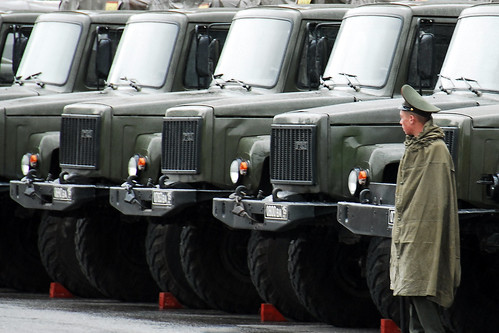
(Image from Tinou Bao’s flickr photostream)