Showing posts with label finance. Show all posts

Thursday, May 14, 2009

Sentences to ponder

Via the World Bank's Private Sector Development blog:
Mongolia is about the size of Alaska and has a population of fewer then 3
million people. This translates into one of the lowest population
densities in the world. With almost half the population living in
Ulaanbaatar, the capital city, and the rest spread out across the country,
it may seem that Mongolia is not the ideal landscape for mobile financial
services...[but] it is actually one of the most banked countries in the
world.

One question worth considering - do all these development finance programs (mobile banking, microfinance, crop insurance) get a free pass on regulation because they are seen as helping the poor? I sure hope not...

Sunday, May 3, 2009

Timeline of the financial crisis

For those of you keeping score at home, VoxEU has a handy chronology of the financial crisis.

Sunday, April 19, 2009

Lehman Brothers: Nuclear power?

Bloomberg broke the story this week that Lehman Brothers Holdings Inc. is sitting on a nuclear bomb's worth of yellowcake uranium. Apparently, the bank physically acquired the uranium after a futures contract matured. It now sits in a secure storage facility in Canada. Which begs the question:

How the hell did Lehman allow this to happen?

Actively traded futures contracts are typically closed out before the contract expires. This absolves the trader/firm from having to take physical delivery of the underlying commodity. It is remarkable that Lehman failed to close such a massive contract. DealBook wonders if the contract simply slipped through the cracks amidst all the chaos of the Lehman bankruptcy.

However it happened, the bankrupt bank is reportedly sitting on the uranium until prices rise; uranium has fallen for five straight months as traders expect delays to nuclear power projects in China and India, and under the expectation that Lehman could dump its stock on the market. Essentially, by holding tight Lehman depresses the very market it needs to recover.

I highlight this story because it underlines just how disastrous, and far-reaching, the Lehman bankruptcy has been. Lehman was an active commodities trader in the broker-dealer and exchange markets, and it got caught on the wrong side of a massive trade that continues to depress an illiquid market. The ripple effects of Lehman's failure haunt us in the most improbable of areas.

(photo source)

Tuesday, April 14, 2009

Democracy and accountability

Megan McArdle has a very interesting piece addressing the legitimacy of the Fed's aggressive, central role in the policy response to the ongoing financial crisis:
But here's the problem: the Fed has performed vastly better on any
metric except "being elected" than the Congress. There's little doubt in
my mind that if we had not had an independent central bank, unemployment would
be many percentage points higher, GDP would have contracted much more strongly,
and we wouldn't now be making optimistic noises about the thing bottoming
out...

I think that the political process will hopelessly screw up the
management of this crisis (something which libertarians are perfectly able to
see when the government screwing things up is a left-wing populist one in Latin
America). But maybe The People, God bless them, deserve to screw up their
economy if they want. On principle, I am opposed to saving people from
themselves. And anyway, maybe I'm wrong and the wisdom of crowds will
prevail.

On the other hand, do they have a right to screw things up for everyone
else? Should a populist 60% be allowed to plunge their neighbors deeper
into crisis? In the case of America, to plunge the whole
world deeper into crisis?

The uncomfortable conclusion I'm coming to is that yes, they
should. Ben Bernanke should be hamstrung even though it's likely that this
would make everyone worse off. And people who advocate for ending the
independence of the central bank should be willing to accept all that this
entails: inflationary monetary policy (the people love inflation!), bad
and unpredictible banking policy, the collapse of the US economy. I just
wish I didn't have to go along for the ride.

Huh? I don't follow her logic at all. A modern democracy is a sophisticated political system. For some specialist functions like monetary policy, undemocratic actors do a much better job. In such cases, democratic lawmakers can voluntarily cede authority to an institution that's insulated from political pressure.

But here's the catch. No one's saying they couldn't take that power back if they wanted to. The Fed's only independent because elected lawmakers chose to make it so. They did this because they judged it to be in the long-term interests of the country.

So do we still have to hamstring Ben Bernanke? I'm just asking. He seems like a pretty nice guy.

Update: By sheer coincidence, Dave writes almost the exact same post at IPE Journal. Really, it's kind of spooky how similar they are.

About that money under the mattress...

Via Bloomberg: "The London interbank offered rate for three-month dollar loans is dropping at the fastest pace since January." This is one positive indicator that credit is starting to flow again in financial markets. At the same time, Goldman Sachs announced that it would sell stock to facilitate repayment of $10 billion in TARP funds to the US government, ostensibly to avoid some of the more prickly (compensation-related) strings attached to the government funds. Goldman Sachs also posted a $1.66 billion profit in Q1.

Good news is welcome news, but two happy stories do not make a turnaround. The Goldman Sachs development may even be counterproductive if other banks rush to pay back their own TARP funds so as not to appear weak, in what would amount to a very public stress test. There is also a danger that Congress, already suffering from bailout fatigue, will become even less inclined to authorize more financial stabilization spending. That's worth keeping in mind, because not everyone is as optimistic as this.

Monday, April 13, 2009

Rags to rupees

India wants its own currency symbol.

The rupee is certainly a strong, and storied, currency, but if China doesn't even have a standardized keyboard and the euro sign isn't yet really universal, what chance does the rupee have of making it as a globally recognized symbol?
The development of a common market (Pakistan, Sri Lanka, and Nepal) would certainly help; bringing together more than a billion people using the same currency in a volatile region would promote greater market integration and freer trade within South Asia. Though not very likely, if implemented, such a momentous change would help to ensure a little more political stability in the 'hood and it just might make for a lasting rupee (and symbol).

(Photo from 8en)

Sunday, April 12, 2009

Failsafe finance?

Dani Rodrik agrees that the IMF is changed, but does not agree that the Fund is now a true lender of last resort. 

Mr. Rodrik's call for stronger national regulation is, in my eyes, (somewhat) correct. Context requires nuanced solutions beyond those that a blueprint framework can provide: this applies from everything from finance to film. His skepticism is healthy, but I remain more hopeful than he that these reforms are at least a step in the right direction. International finance may not be safe, but was it before this mess?

Wednesday, April 8, 2009

A false dawn

April is the cruelest month - if you're an economist. Seriously, the dismal science has outdone itself in the past week. Here are some graphs charting the collapse in trade flows. (Bonus: here are some related statistics and graphs tracking the slowdown of bilateral US-UK trade). Here are some measuring the even faster disintegration of capital flows. Here are some which show that by every indicator, the global economy is tracking or doing worse than during the Great Depression. And here is the impossible (to paraphrase Felix Salmon) list of things we would need to do to avoid another Black Swan like this occuring in the future.

I am most troubled by the argument that current aggressive policy responses may eventually end the recession without addressing the fundamental problems which caused it in the first place. Green shoots? Try cold snap.

Tuesday, April 7, 2009

Fund-amentals

Plenty have highlighted the promises to the IMF as one of the greater success of the G20 Summit. Free Exchange doesn't agree:
In the quest for a big headline number to throw at the world and the press, and in an attempt to equate this to the missing globally coordinated fiscal stimulus, there's been a fair amount of hand-waving. Of the money that the IMF is supposedly getting, the only clear new commitment is a relatively small $40 billion from China.
True, the new commitments aren't as stellar as the media is reporting. But, the big change is not the new money; it's the Flexible Credit Line. To be fair, the author correctly notes that countries aren't exactly lining up for these IMF handouts. But if Mexico has a decent time with the revamped IMF system, you better believe a few more governments will be putting in a call to Mr. Strauss-Kahn.

Besides, the amount of money isn't that important: it's the fact that after years spent resisting change and asserting their right to essentially dictate monetary policies to countries (ahem, Thailand), the IMF is loosening its grip, albeit slowly. Countries still must have "sound monetary policies" to qualify for these new loans. But the definition of "sound" hasn't been spelled out and more importantly, the loans don't come with IMF staff. With nationalist rhetoric rising in the wake of the financial crisis, taking IMF money is going to be a much easier political sell if it doesn't come with resident Fund officials. The US and Europe may still have de facto veto power within the Bank group, but that's something most people won't know when they head to the ballot box.

(Photo from Kyrion)

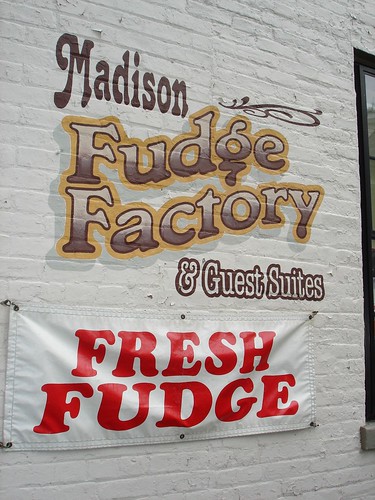
A chocolaty financial crisis metaphor

Among all of the recent metaphors used to describe the financial crisis, this one takes the cake (or fudge).

Special thanks to The Browser and The Financial Times.

(Photo from merfam's photostream)

Monday, March 30, 2009

Gallows humor

President Obama has had a rough few months. As the global economy continues its slide, what the crisis means for global trade and financial regulation will dominate discussions in London on Thursday. Rightfully so. After the economy, North Korea's impending missile launch and Afghanistan's gradual decline into disarray dominate any foreign policy discussions. With so much on his plate, not to mention health care reforms and an understaffed Administration, Iraq has fallen by the wayside. The President has admitted as much.


But lest we forget how perilous the gains we've made in Iraq are, Tom Ricks is happy to remind us:
The Maliki government is putting the screws to the Awakening movement (for those who just arrived, that's a mainly Sunni group of about 100,000 people, many of them former insurgents, who in late 2006 and 2007 arrived at ceasefires with the U.S. military presence in Iraq). The American plan was to integrate 20,000 members...into Iraqi security forces, and help the rest find other work...But the Shiite-dominated Baghdad government never really like the idea. Indeed, the first deals were cut by U.S. officials behind the back of the Iraqi government...I think Maliki's gambit is to crack down on the Sunnis while American forces are still available in sufficient numbers to back him up. This is turning into a test of strength, Sunni vs. Shiite.
Sound familiar? 

The President may be better served to focus on actually shoring up our international standing, rather than just paying lip service to the notion while using our current crisis environment to push big government, domestic programs that most independent voters hoped he would avoid.

Tuesday, March 24, 2009

A visual explanation of Geithner's two-pronged plan

The FT has a handy graphic explaining how Secretary Geithner's plan will actually work if you're a little bit confused.

The inflation hedge of choice

On Wednesday, the US Federal Reserve "shocked the world" by announcing plans to buy $300bn of government debt and double its purchases of Fannie and Freddie securities. According to the FT, once the Fed's plans are fully realized its balance sheet could swell to $4,ooobn, one third the size of the US economy. Hellicopter Ben, meet Bazooka Ben.

The Fed's actions are an attempt to literally shock life into the credit markets. It may also have the convenient effect of driving down the cost of government borrowing. However, the Fed runs the very real risk of stoking a very big inflationary problem down the road. Weimar Republic the US is not, but the money supply is growing at such a rapid rate that the Fed had better hope the US economy rebounds this year. Remember central bankers, there are unintended consequences to such dramatic monetary easing; like say, a housing bubble (Mr Greenspan, I'm looking in your direction).

What then are some of the likely consequences of the Fed's policy innovations? For one, the dollar was the big loser last week; in fact, it registered its worst week against the major currencies in 24 years. This fed into an accelerating rally in commodities, the moment's inflation hedge of choice. The benchmark S&P GSCI index was up 8% last week. Or take copper, up some 28% this year, a feat completely divorced from the underlying fundamentals. Though, the FT has an article this morning on the actions of a "secretive" Chinese state institution stockpiling copper supplies (which sounds like the perfect plot for Bond film). Oil is back over $50, supported by the OPEC cuts, but boosted in recent weeks by Fed policy. The speculative inflow into commodities, as an asset class, may be small compared to the bubble of recent years, but it is nonetheless paring the steep losses experienced in the second half of 2008.

The sustainability of this rally is highly suspect. With Chinese growth forecast at 6% for the year, and the G7 contracting by 3.2%, the global recession will depress demand for commodities well into the year (with the possible exception of food, but that's another discussion). However, loosey-goosey monetary policy (as A-Rod would call it) comes at a price, with inflation second only to a loss of confidence in US treasuries. Bernanke has demonstrated that he is willing to throw everything in the Fed's arsenal at the credit markets. Until he wins, expect commodities to outperform as an asset class.

(photo courtesy of Shiny Things' photostream)

Friday, March 20, 2009

Mo' Rubles Mo' Problems

Amidst the spring-time clouds and snow over the Moscow sky, there appears to be one bit of good news: the ruble, for now, seems to have stabilized, defying the critics of the Kremlin’s ruble stabilization program. When I was in Russia just two months ago, every stop at the ATM was like a special delivery from Ded Moroz, as the RUB/USD rate dropped from 29 to 32 in 8 short days. In the spirit of the season, I decided to do my part for the economy by “donating” my extra 10% of purchasing power to the fine brewhouses and eating establishments of St. Petersburg.

Yet, before we start celebrating, we should keep in mind that movements in the ruble have correlated almost entirely with movements in the price of oil, which is really the only marketable Russian export (in addition to vodka, defunct ideology, and depressing literature), and thus the indicator for the overall Russian economy. As crude has now stabilized above $40/bbl, so the ruble has stabilized below the euro-dollar basket of 41. This is a good thing, but it can also create an illusion of stability and economic upturn. Meanwhile, inflation continues to soar in Russia, outpacing other Eastern European countries. While inflation has picked up, salaries, both nominal and real, have been falling, and consumption has dropped sharply – it has even hit one of the most rock-solid sectors of retail! Sadly, many of my friends have recently had to choose between leaving their jobs or taking pay cuts of up to 50% - one friend tells me that her employer has not even paid her in the past 2 months, and she has taken out a line of credit to fund her basic living costs.

This last part is particularly worrying, especially since ruble stabilization has necessitated a significant rise in the already sky-high interest rates for personal and business loans at Russian banks. Faced with double-digit interest rates, Russians have done what many in the former Communist bloc have done over the past few years – take out loans in foreign currency, particularly in Euros, at much lower rates. This was great when emerging markets were booming, but now that currency devaluation has hit, consumers and businesses are struggling to make payments, with the latter raising prices on goods. Already in Russian cities, most real estate rental prices are set in Euros. As small businesses get hit with higher real costs for rent and loan payments, prices continue to rise. Moreover, as confidence in the ruble continues to wane, the desire for holdings (and lending) in foreign currencies grows still.

What is the Kremlin to do? Lowering interest rates on loans below the current 13% inflation rate would effectively mean government subsidization of lending, and would drive further devaluation of the ruble, and price inflation for imported goods. While this could cause a further flight of capital from Russia and could plant the seeds for ‘90s era economic chaos, it could also stimulate lending and growth, if coupled with prudent policy reforms, particularly toward small businesses which are drowning in bureaucracy and corruption. It might also cost the Kremlin less, and be more effective, than continuing to subsidize banks who then speculate against the ruble in the Forex markets. Keeping interest rates high, however, may create the illusion of stability, but will surely continue to stifle growth, and will hurt ordinary Russians most. In any case, winter in Russia may not end for some time to come.

(photo from Alcoyotl's photostream)

Thursday, March 19, 2009

Quantitative easing explained

The FT has a great new interactive feature explaining the central bank policy of quantitative easing. The British narrator sounds reassuringly competent.

Monday, March 16, 2009

I thought the culture wars were over

 
Calvinism is back...John Calvin's 16th century reply to medieval Catholicism's buy-your-way-out-of-purgatory excesses is Evangelicalism's latest success story, complete with an utterly sovereign and micromanaging deity, sinful and puny humanity, and the combination's logical consequence, predestination: the belief that before time's dawn, God decided whom he would save (or not), unaffected by any subsequent human action or decision.
Is this for real or is religion simply a counter-cyclical asset?

Sunday, March 15, 2009

Tuesday, March 10, 2009

Everything you ever wanted to know about the gold standard

Or, what feels like about half of what Dave, Rory and I studied for our Master's Degree. The post is here.

(HT: The Big Money)

Monday, March 9, 2009

Future of capitalism

This week, the FT is having a debate on the Future of Capitalism. Here's a sobering excerpt from Martin Wolf's opening salvo, titled "Seeds of its own destruction:"

"These changes will endanger the ability of the world not just to manage the global economy but also to cope with strategic challenges: fragile states, terrorism, climate change and the rise of new great powers. At the extreme, the integration of the global economy on which almost everybody now depends might be reversed. Globalisation is a choice. The integrated economy of the decades before the first world war collapsed. It could do so again."

The food crisis never ended

Christopher Delgado, an agricultural policy advisor at the World Bank, recently said of the global food crisis, "The food crisis has not gone away...In fact, it is coming back."

Combing through the media, it would be easy to assume that the food crisis had long ago subsided as demand for imports, commodity prices and economic growth declined. However, risks to food security and the possibility of famine are still very high in many countries. While food commodity prices have fallen from their record highs in 2007, the US Department of Agriculture forecasts that they will remain above historical levels in 2009. The combination of rising food prices, economic contraction, export/price controls and tight trade credit exposes many vulnerable countries, particularly LDCs, to serious risks of famine, poor crop yields and higher prices coinciding with falling income. This doesn't even begin to include the impact on food production by drought, land degradation and other environmental conditions; the UN recently warned that global food production may fall 25% by 2050.

Given the still prevalent risks, it is disconcerting that less is being done to combat the problems directly. Further, certain policy responses to the financial and economic crises, such as looser monetary policy in the developed world, or expropriation in countries like Venezuela, risk stoking the rising food commodity prices. Which brings me to the real danger on the horizon (beyond, of course, the human cost): that the financial, economic and food crises will reinforce each other in a vicious cycle. A food crisis is a likely second-round affect of the financial and economic crises, which in itself breeds political and economic instability, undermining the recovery process and further destabilizing the global economy.

Policy responses to the financial and economic crises are understandably driven by the need for immediate action; to stop the bleeding, so to speak. But what if the very policies necessary to bring us out of this downward spiral only reinforce it in the medium-term?

(photo from snake.eyes' photostream)