Tuesday, September 30, 2008

The financial stakes of inaction

Long-time Zeitgeist (and real life) friend Matt points to Jeffry Miron’s commentary on CNN in response to the rant I posted yesterday. Mr. Miron argues, in essence, that the bailout is a poor idea and that insolvent financial firms should instead declare bankruptcy. Why should taxpayers prop up failed firms that made reckless decisions? In a free market, winners are rewarded, and the losers fail. That’s how it ought to work. I’ve heard this argument from a number of readers and I realize that I need to do a better job of explaining why I think government intervention is necessary.

The key to understanding the importance of the bailout is framing the issues at stake. The idea of saving Wall Street financial types who should be punished (in a market sense) for their poor decisions is difficult to stomach. But this is an unavoidable side effect of the bailout, not its central intent. The bailout essentially proposes that the government purchase toxic assets that nobody wants, because only the government has sufficient capital to do so. The reasoning is that by doing this, you save people who have made poor decisions, but much more importantly, you relieve the enormous pressure in the financial system and help put it on its way back to normality.

Many people think that statements like that (aka “saving” the financial system) amount to fear mongering. Perhaps they do, but the problem is that nobody knows. I believe that by doing nothing, we are taking a large gamble on a significant economic downturn. The best indicators, which are admittedly crude, as well as most financial experts suggest that there exists a massive crisis of confidence in the markets. Confidence underpins well-functioning financial markets. I think this is a point that Mr. Miron acknowledges but brushes over far too quickly. When institutions are nervous about lending money, they price that perceived risk into the interest rates they charge. During times of low (or, as it is right now, historically low) levels of confidence it becomes very difficult or much more expensive to borrow money.

Credit, in turn, is absolutely essential to the normal functioning of an economy. Every time you use a credit card, you’re borrowing money. More importantly, businesses rely on credit to smooth out consumption and meet their debt obligations (like paying workers). Entrepreneurs rely on credit to turn their ideas into the next Google. With a little imagination, it is not hard to see what happens if liquidity dries up and confidence erodes. Main Street and Wall Street are very closely tied together.

The difference is that markets are so spooked right now that evaporation of credit could happen on a massive, never-before seen scale. Willem Buiter gives a “quite likely” scenario of what could happen in the near future. It’s too long to quote here, but I strongly encourage you to read it. Tyler Cohen, one of the most level headed and reasonable people, adds a best and worst case scenario. The best case is a two year recession and 8-9% unemployment.

Again, the naysayers may argue that this hyperbolic, and that these exaggerated worries do not justify backing an admittedly poorly-designed and possibly enormously expensive rescue package (although the cost is debatable as it's an investment). I do hope that the worries prove overblown. But my own understanding of the situation, as well as the opinions of people I strongly respect, point me towards endorsing government intervention. There's no guarantee that it will work, and it certainly won't right the systemic problems overnight. But I’m still not convinced that the gamble of inaction is one worth taking.

I’ll end by quoting Steve Pearlstein’s column:

“Americans fail to understand that they are facing the real prospect of a decade of little or no economic growth because of the bursting of a credit bubble that they helped create and that now threatens to bring down the global financial system.”

Foibles not follies

There's another beleaguered executive making news and his name isn't Bush. Soon to be former Prime Minister of Israel Ehud Olmert sat down for an interview this week to discuss the state of Israel. Typical of a politician, Olmert has now called for action that needs to be taken when he can do nothing about it (he resigned due to corruption charges earlier this month but remains the interim PM until a new government is formed). His formerly astringent stances have been softened into calls for a unified, realistic strategy of engagement and dialogue with Palestine, and more importantly, Iran.

It's convenient that Olmert chose this moment to reshape his own policy views. The Israeli stock market has been largely unaffected by global credit problems and with the New Year just around the corner, his interview is front page news. And the right type of front page news, an about turn from his corruption battles the past few months. Olmert now knows an Israeli withdrawal from the West Bank, along with a partition of Jerusalem, is the bare minimum for sustained peace.

Just as important, given the recent rumors about preemptive strikes on Iran, is Olmert's assertion that Israel must act within the international system in addressing the threat of Iran. For all the rabble rousing both candidates spout regarding Iran, it is important to note this about turn. Ahmadinejad is up for re-election in June 2009. His apocalyptic, "Hidden Imam" brand of Islam not only contradicts the Ayatollah's more compromising Mashad understanding which values preservation, but is quickly losing support from the populace. His control of the nuclear program is dangerous but overstated, just like his rhetoric. Olmert's realization that unilateral action is even more dangerous than Ahmadinejad represents a correct and noteworthy policy shift. It may be a particularly weak turn given his current position, but it is one worth supporting.

Monday, September 29, 2008

Bailout blues

Market: heal thyself. That’s essentially the message Congress sent the financial system today by voting against the bailout. I must admit that I’m caught off-guard, because I always assumed that the bill would pass. Normally, considering the gravity of the situation, party leaders never would have let this come to a vote if they didn’t think they had enough support to pass it.

Perhaps this speaks to how tepid support for the bailout actually was, but this was never news. Who would relish spending more than the total cost of both our current wars in Iraq and Afghanistan on something that is poorly understood, roundly criticized, and widely disliked by the public? Nobody, especially not politicians, who of course have a sixth sense for protecting their own skin. The point is, as Messrs Bernanke and Paulson made clear this week, the bailout may be wildly unpopular, but it is also badly needed.

There is plenty to say about the plan’s efficacy, about its design, and about whether it would succeed. These are legitimate debates, which we need to have. They’ve played out nonstop since intervention was proposed about 10 days ago, and there are strong disagreements about how to proceed from every possible ideological viewpoint. Tellingly, the sole consensus among the levelheaded seems to be that the only thing worse than action is inaction, especially after the government implied that it would intervene. By my reading, everyone from Megan McArdle to Paul Krugman held their noses and endorsed the bailout.

Party leaders on both sides of the aisle understood the urgency and gravity of the situation. Hell, I’ll go further and argue that the rank and file party members understood this, ideological revulsion of the idea aside. I simply refuse to believe that there is even one member of Congress who does not appreciate how dire the circumstances are, even if they don’t grasp the financial nuts and bolts.

And yet, the bailout failed. Why? Some blame Nancy Pelosi’s “overly partisan” speech before voting. Some cite ideological qualms that were too great to swallow. Hogwash. Felix Salmon nailed it: this was a classic free rider problem. Collectively, the members of Congress expected that they would pass the bill, yet it was simultaneously in representatives’ personal interests to vote against it. As long as the bill passed, any Congressman who voted ‘no’ would doubly benefit. They would be able to claim to their constituents, mostly opposed to the bailout, that they made a principled stand and voted ‘no’, AND the dirty work would be done by others. The problem is, predictably in a free rider situation, too many people tried to take the easy route and the bill failed.

I am absolutely livid that Congress, even in a time of such great economic danger, would put their own partisan interests before what is best for the country they profess to serve. Read Megan McArdle’s scathing condemnation; that’s exactly how I feel at the moment.

So now the Dow has fallen 778 points in one day, which is a historical first. The S&P is down 8.8%, the largest fall since the 1987 crisis. The TED Spread is up 23%. This is very unnerving stuff, people. You remember in Ghostbusters when that jerk from the EPA shuts down the ghost storage facility even though Egon tries to talk him out of it? And then the buzzer goes off and all the ghosts are set loose and terrorize New York City? I hope that the experts are wrong, but that’s what today feels like: voting ‘no’ on the bailout was sort of like ignoring Egon, and you never ignore Egon.

Saturday, September 27, 2008

Post debate thoughts

Two caveats: first, this is not a partisan assessment, although, for what it’s worth, I spoke briefly with my coauthor after the debate and we both thought it was roughly a draw. You probably didn’t learn much unless you’re tuning into the race for the first time. I found the whole thing rather dull, with both candidates, especially JM, talking past the other. Second, I strongly suspect Tom Friedman will write his next column about roughly these same issues (although I imagine he’ll hone in on energy).

Perhaps it is asking too much, but I am enormously frustrated that the 2008 ‘foreign policy’ presidential debate is still framed almost entirely in terms of the ‘high politics’ of security. Let me be clear: I understand that the US is fighting two wars, and that Iran is trying to acquire nuclear weapons. These issues are of paramount importance, and we need to hear what the candidates think. But there is a lot more going on in the world that Americans need to talk about.

We heard nothing about multilateral trade, little about energy (except when framed as a mercantilist issue of ‘energy independence’), little about China (except when BO framed it as a vague threat), nothing about India or Brazil, nothing about climate change, nothing about reforming the multilateral institutions (except for JM’s patently absurd and impractical “community of democracies” idea). These are enormous issues.

How, in practical terms, should the US encourage China to become a responsible stakeholder in the global political economy? Are they already? Do we view them as a threat? If so, why?

How would either candidate advance multilateral trade negotiations? Would they?

How do we foster links with Brazil, one of the world’s most important and largest emerging markets?

Is it worth weakening the NPT to foster nuclear ties with India? How does that fit into America’s strategic vision?

What practical steps would either candidate take to combat climate change, by definition a global issue?

I am struck by an insightful point that Fareed Zakaria has made recently. US foreign policy focuses on the ‘losers’ of globalization (terrorists, failed states, etc). At best, that’s half the coin. In the long run, the greatest challenges (or if you’re optimistic, opportunities) come from the winners. Whoever chose the questions for this debate did Americans a great disservice by neglecting to address those winners.

All I’m saying is, if you keep telling people that globalization is this scary, negative thing that eliminates jobs and empowers COMMUNIST CHINA, it’s no wonder they’re going to hate it…

Am I asking too much?

Friday, September 26, 2008

I was elected to lead, not to read!

Well we are at crisis levels. The bailout, which plenty of people say won't work anyway, has stalled in an incredible fashion today. I won't try to give a run down of the issues at hand, but let's be clear that neither I, the President, nor both candidates fully understood the subtleties of our current pickle, despite the stellar briefings I'm sure they have all received. Apparently neither do any of our elected representatives because despite all of the calls for immediate action we are being greeted with limp and tepid responses carrying no weight. For clear explanation read these concise and lucid treatments of what's happening and why.

As Brad Setser points out, the balance sheet of the Fed reveals the huge nature of the deal. It's sad, and in this situation downright scary, that an election season filled with promises of bipartisan compromise has devolved into another typical session of Washington malaise. To be perfectly frank I'm ready for some good 'ole unilateral, unchecked decision making rather than this current handwringing and indecision. And besides, Paulson isn't nearly as bad as Russ Cargill.

Thursday, September 25, 2008

Russian military capacity

During the Russian-Georgian War this summer, I noted that military analysts the world over would be watching carefully at how Russia fared in its first conventional conflict since Afghanistan. In an article in last week’s Economist, the verdict is in: Russia didn’t do too hot. I strongly encourage you to read the entire thing, but here are the best bits:

· Russian military communications equipment was so dysfunctional in Georgia that the army resorted to using mobile phones to coordinate positions. I can’t help but wonder if they had to pay roaming charges.

· Despite all of the bellicose rhetoric about naval buildup and the imminent construction of 5 or 6 new aircraft carriers, Russia doesn’t even have a naval port with the capacity to build them.

· Although Russian defense spending has doubled in the past 4 or 5 years, massive and systemic corruption ensures that about a third of the funds are wasted.

· In a notable reversal of Cold War geopolitical calculus, Russia now relies on its nuclear deterrent to offset the West’s overwhelming advantages in conventional military combat. It used to be the exact opposite.

While it’s important to acknowledge Russia’s newly aggressive behavior, one should not conflate the willingness to use force with the capacity to use force. Russia remains a threat to its immediate neighbors, but, joint military exercises aside, the country has an incredibly limited capacity to project hard power further than that. In short: Russia is powerful, but that power is constrained by realities (an economy based on resource extraction, corruption, weak institutions) that will make it difficult to sustain.

(Photo from Oleg Zdorik’s photostream)

Wednesday, September 24, 2008

Zeitlinks

It’s fall, Patrick’s fantasy football team is 3-0, and the Skins are somehow 2-1. Oh, and a conservative American government is proposing the largest financial bailout in the history of mankind. (Posting a day late due to technical difficulties...)

Nick:

1. India's in: I don't normally care for Gideon Rachman but he hits the nail on the head in recognizing the reality of India's nuclear status.

2. I feel a lot better: that Steven Levitt admits he hasn't the "foggiest idea what all this means". But I'll trust who he trusts. Diamond and Kashyap on financial upheavals.

3. The Bottom 1.4 billion: Paul Collier appeals to the UN for not more aid, but more policy on poverty issues. TED talks are really sweet if you don't know.

4. Too: Did the creator of Google really JUST start a blog? Two thoughts: shouldn't it be a little more put together and isn't Parkinson's a gloomy topic for a first post? I'm just saying.

Patrick:

1. Insiders Save Themselves: Megan McArdle has proven herself even more essential than usual throughout this whole financial mess.

2. Who’s at fault: When it comes to bad loans, it’s also important to remember that it takes two to tango….

3. What I’ve learned from six years of blogging: If only we could all be as prescient as Dan Drezner. This post should be required reading for all politics, economics and policy bloggers.

4. Only By the Night: Kings of Leon return with a 4th album. Nuff said.

Tuesday, September 23, 2008

Try, try again

Last week I blogged about how New York would almost certainly face serious problems due to the loss of taxable revenue from Wall Street. Guess what?
Mayor Michael R. Bloomberg’s budget director ordered agency directors on Tuesday to cut spending by a total of $1.5 billion over two fiscal years, starting with the current fiscal year, which began on July 1. The spending reductions come as the mayor is floating the idea of a 7 percent property tax increase on homeowners, a move that could generate an additional $600 million in revenue each year.
Try again, buddy. Instead of subsidizing projects in areas that could bring in serious tax cash for the city in addition to making up the differences of rent controlled apartments, let markets developers do their job. You're still gonna be short but if you are seriously thinking about running again (and having enough support to change the laws to allow it) higher taxes ain't the ticket. Not this year.

Monday, September 22, 2008

The credibility crunch

As I mentioned briefly last week in Zeitlinks, one of the greatest casualties of the current financial crisis will likely be the credibility of American-style, lightly-regulated capitalism. Today, via FP Passport, I saw that President Lula da Silva of Brazil couldn't resist taking a potshot at the American banks involved:
Important banks -- very important banks -- that spent their lives giving advice about Brazil and what we should or shouldn't do are now broke.
Ouch.

Multinational corporations and censorship

Via Frostfirezoo, here’s an interesting picture of image search results for Tiananmen on normal Google and Google China. The results, unsurprisingly, vary wildly depending on whether you search from China or not.

I find this sort of problem immensely interesting and a serious gray area. Google has taken a lot of heat for this in past. On the one hand, you have a company whose corporate motto is “Don’t be evil”, yet hiding the uncomfortable truths of history for one fifth of humanity is hardly model behavior. On the other hand, the government of China has always been able to leverage the size of its domestic market to impose strict constraints on how foreign companies operate within its borders. The Communist Party of China will control the flow of information, whether or not Google is there. Should Google deny itself (and its shareholders) the benefits of operating in an enormous market because of realities that it has no control over?

There are externalities as well. In sum, is the fact that Google operates (even if search results are skewed) a net benefit for the Chinese people? I’m sure that you could make a convincing case for it: I’d be lost without Gmail, Gcal, and Google Reader (and this blog probably wouldn’t exist.) Again, though, we’re talking about one of the world’s preeminent technology companies: is it really fair to let them off the hook so easily? Shouldn’t they have used the leverage that this position gives them more aggressively?

There are no right answers here, but I think this is a great example of how complicated and nuanced the great issues of international political economy are. Feel free to hash it out in the comments. For what it’s worth, I believe that China’s bargaining power was significantly larger than Google’s. I’m willing to take some unavoidable censorship now with the hope that things will evolve as China becomes richer and more integrated into the world economy.

Friday, September 19, 2008

All quiet on the Western front?

Any talk of Afghanistan these days usually revolves around its porous border with Pakistan. Common sense wisdom says that Tailban militants are hiding out in the terrain that straddles the desolate area known under a variety of guises: FATA, Warizistan, North West Frontier Province.

While it's certainly true that funds and arms pour in from Pakistan, well-founded rumors are also circulating that Iran is smuggling arms and cash in exchange for drugs to the Taliban over the western border as well. This is scary, probably true, and should be just as high on our security agenda as the Pakistani border. Iranian influence was what caused, in part, the severe sectarian strife in Iraq. It's pretty obvious that's the last thing we need in Afghanistan. And it is certainly true that the violence once contained in the south and east has been increasing in the western countryside.

As a possible nuclear power with delusions of dominance and influence throughout Central and South Asia, Iran's role in Afghanistan offers a chance to pursue a more fruitful strategy of engagement and stabilization in both countries. The US can either rebuff Iranian efforts unilaterally in which case arms will continue to flow into Afghanistan and probably increase. Or measured steps can be taken to allow Iranian efforts greater importance. Iranian desire to expand their regional influence through aid efforts is a concern but much less than an increase in their arms smuggling. Iran has been a heavy giver in the international reconstruction effort and was a vital lynchpin in negotiating the Bonn Agreement, which established Afghanistan after the fall of the Taliban. They want a greater role in guiding the future of Afghanistan and if they aren't given a seat at the table will continue to destabilize our efforts in the country.

Their role gathering support from normally aloof countries, with little desire to be tied to an American led invasion, was vital to securing international and regional support in 2001. Let's treat it as such and give them something better to do in Afghanistan than run guns.

(Photo: fallenwattle)

Thursday, September 18, 2008

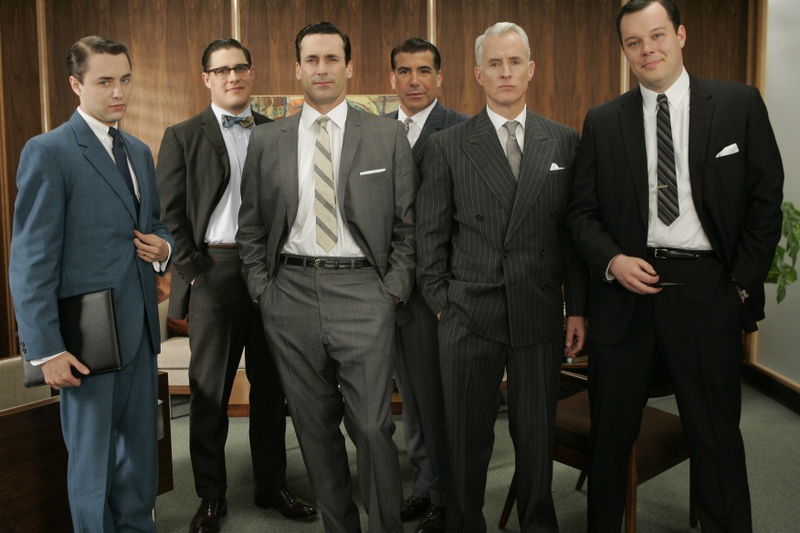
Mad Men and consumption

Thanks to my illustrious coauthor, I’ve become completely hooked on Mad Men this past week. If you aren’t watching, you’re missing one of the greatest shows on television right now. It’s set at a fictional Madison Avenue advertising firm in the early 1960s. Aside from being a great drama, it meticulously recreates that halcyon era of American life.

While watching it, I couldn’t help thinking about the economic angle as well. In a lot of ways, it’s also a show about being rich in the early 60s. What did that mean? For Don Draper, the main character, it’s a huge house in the suburbs, a fancy car, and a high degree of leisure consumption in the swankiest parts of Manhattan. But what makes the show truly great, in my opinion, is how it faithfully captures the social mores of the period, which informed people’s behavior. What I found truly striking on the show is how everyone consumes like nothing is ever going to run out. There seems to be an undercurrent that things can only get better, which dovetails nicely with the economic realities of the time (postwar expansion, yet to be interrupted by the oil shocks of the 70s). Contrast that with today, where we have a massive climate change problem and economic uncertainty, and (right or wrong) Malthusian predictions about humanity’s ability to feed itself are common.

A simpler era? (Putting aside that whole mutually assured destruction thing, of course...)

Zeitlinks

Finance, insurance, automakers...what other evidence do we need that the world is literally falling apart? Well, the Minnesota Vikings just named Gus Frerotte their starting quarterback. If you need to distract yourself from the fact that your fantasy team is now in the crapper, as mine is, here is some of the week's best...

Nick
1. The good news: Tyler Cowen looks for a silver lining amidst the financial crisis and finds very little. If nothing else, read the last paragraph. He echoes my concerns on the legal precedent and implications for governance the flurry of bailouts may set.

2. How Bad a Rift? If you haven't heard, the US has pushed the envelope and is now conducting military raids and air strikes in Pakistan. Though the rational is founded (militants are famously crossing the border into Afghanistan), Pakistan is not ready to accept these incursions and has ordered troops to fire on any American forces crossing the border. We need greater dialogue and cooperation or the result may be our loss of a key ally.

3. The real difference between liberals and conservatives: Psychologist John Haidt has a fascinating TED talk on the neurological basis of our moral values that mold our political beliefs. Do watch the whole thing...I guarantee a fascinating 20 minutes.

4. Capping aid to Africa: On the heels of a controversial column in FT and a summit on aid effectiveness in Accra, the Center for Global Development sums up the reactions of the field's most knowledgeable practitioners and scholars.

Patrick

1. Oil Prices Break Back Above $100: Conversely, the executive director of the IEA warns of a global recession if prices stay above $90; meanwhile, Goldman Sachs revises their end of the year oil price forecast down to $115/barrel from $149/barrel.

2. Less than zero: Hmmmm.... should I put my money in 3-month T-Bills or just stuff it under my mattress?

3. The Culture that is French: A little-discussed but significant casualty of the financial crisis: American capitalism's international street cred.

4. Peak oil wrong, says Schwartz: Futurist Peter Schwartz has some sharp words for the peak oil crowd. Will oil scarcity be severe enough to actually drive clean energy investment?

Wednesday, September 17, 2008

Buy American? Or bailout American?

News is out today that Chrysler, along with GM and Ford, will most likely receive somewhere in the neighborhood of $25 billion in government loans to "assist" them in advancing innovation. American automakers are certainly "not too big to fail". If anything the long, slow decline of one of the three would prove a boon to consumers. Keep in mind, as I noted before, Chrysler is not a public company. Private equity firm Cerberus owns an 80% share of the company. If Chrysler dies, the entire loan industry doesn't go up in flames, a few board members of one of the wealthiest companies in America do.

Chrysler obviously won't be going up for sale anytime soon as I previously surmised. This isn't the first time Chrysler has received government help. In the late 70s the company received $1.5 billion in loan guarantees to avoid bankruptcy. Back then, the company used the money to settle workers' issues (health care and wage raises) and instead of "innovating" took to bashing Japanese companies and advocating buying American. This, ladies and gentlemen, is the very definition of moral hazard. Let's hope we are not being hoodwinked again.

(Photo: Bruce Campbell)

An oily predicament

This sentence caught my eye in the dead-tree version of the Washington Post this morning:
"An oil drop of $30 a barrel is significantly more damaging to Iran's economy than UN Security Council sanctions," said Karim Sadjadpour, an associate at the Carnegie Endowment for International Peace. "That's a loss of about $75 million per day in oil revenue. A further drop in prices could play a decisive role in the June 2009 presidential elections, for it could deflate [President Mahmoud] Ahmadinejad's populist agenda."
Common sense, perhaps, but still quite powerful.

Tuesday, September 16, 2008

On bailouts and buyers

Not to make light of the recent troubles on Wall Street but Megan McArdle echoed today a thought that had been running through my head given the bailouts, conservatorships, or whatever the Paulson and the Fed want to call their actions to keep Americans happy.
All of New York's rebound has been paid for by taxes on the financial industry -- a few hundred thousand people in the industry pay the lion's share of taxes for the entire city. Tale them away, and the city will rapidly lurch bak towards bankruptcy.
One question. Is Bloomberg going to bailout the City if the Korea Development Bank doesn't bite?

(Photo by Christopher Chan)

Zeitlinks

The sky is falling on Wall Street, but here at Z’geist we try to find the silver lining. The crisis is giving us a chance to try out new branding strategies… what do you think of our new slogan??

ZEITLINKS: Now more reliable than complex financial derivatives!


Nick:
1. Segregation and the quality of government: Alberto Alesina has a great new article on how ethnic fragmentation undermines governance efforts. Read the whole thing and keep in mind colonial powers used to segregate ethnic groups specifically to strengthen their government by dividing any anti-colonial opposition.

2. Petraeus' Legacy: General Petreaus leaves behind an Iraq that has improved during his tenure but that still leaves much to be desired. Keep in mind that most of his success is premised on Iraqi insurgents being brought onto the US payroll. He has accomplished alot but military strategy is never the whole story.

3. A changing climate of opinion? The Economist has a wonderful piece outlining the more radical proposed solutions for global warming. Will these ideas go the way of the jetpack? Who knows but in the meantime they're interesting.

4. RIP David Foster Wallace: The literary giant of our generation has hanged himself. You will be missed. If you don't know this man, go buy Infinite Jest right now.

5. Palin has a cooking show?


Patrick:
1. McCain Financial Advisor’s Sunday Op-ed: I’m not a huge Wonkette fan anymore, but sometimes they just knock one out of the park.

2. John McCain’s “Big” Economic Plans: Mark Thoma has a look at what J-Mac says he’ll do to the economy.

3. Dilbert’s Poll of Economists on Obama vs. McCain: Tyler Cowen points to an interesting poll of economists’ political preferences. Notably, John McCain inspires much more confidence than Barack Obama in regards to international trade.

4. Dani Rodrik is blogging again: I’m sure someone will write a post on his new article soon. But his return to the blogosphere is one reason to be happy that summer’s over.

Crisis on Wall Street

The financial crisis has deepened on Wall Street. Yesterday, Rory at IPE provided a great overview of what happened over the weekend. Here at Zeitgeist, we’re following the developments quite closely. Lacking a purely financial background, I don’t feel qualified to comment extensively on much of what’s going on. The news is changing hourly, and I recommend that you to check in often at the following blogs: Free Exchange; Felix Salmon; Calculated Risk; and Economist’s View, among others.

I’m on more comfortable ground in regards to the political-financial aspect, and I have a couple thoughts. First, kudos to Hank Paulson for drawing a line in the sand about public bailouts in regards to Lehman Brothers. Moral hazard is an underlying quality of all government-private sector financial interactions. Lehman has been slowly dying for months, and investors have had ample time to readjust. The Treasury has taken a risk that markets are robust enough to weather its failure. However, if Mr. Paulson had allowed another Bear Stearns, the floodgates of federal money would have been much more difficult to close in the future, and it hardly looks like Lehman will be the last financial institution to come knocking. Conversely, AIG might fail in the next day or two if the insurance firm is unable to secure additional credit lines and is possibly another story. Mark Thoma weighs both sides of a potential bailout of the insurance giant.

Clearly new regulation is needed. The key here is that better, not more, regulation is needed. As Mr. Paulson has stated, the financial regulatory structure is a patchwork, hopelessly outdated, and simply not up to the task of 21st century financial globalization. This is an extremely complicated policy arena, and I’m very nervous that Congress isn’t up to the task right now. Congress often likes to be seen as “doing something”, but in this situation, uninformed debate and ill-considered new regulatory legislation will make things worse. Everyone needs to be as careful, and as level-headed, as possible. Perhaps this is asking too much: it is an election year after all. But further to that, I strongly agree with Megan McArdle that this should not be a campaign issue. This would have happened just as easily under a Democratic president as a Republican one.

Finally, on the lighter side of things: Donald Luskin, who penned a snarky and bitterly partisan op-ed in Sunday’s Washington Post about how well the economy is doing, is now a strong favorite to win the award for WORST. TIMING. EVER.

(photo by HKmPUA)

Monday, September 15, 2008

Fighting the man

An interesting paper by Rafael La Porta and Andrei Shleifer presented at Brookings this past week explores the connection between activities in the informal economy and economic development. 

Tyler Cowen agrees with the authors that the the registration and growth of official firms is needed to drive economic growth in the developing world. 
The evidence points to the dual view, with the fairly standard implication that the hope of economic development lies in the creation of large registered firms, run by educated managers and utilizing modern practices, including modern technology, marketing, and finance.
This seems pretty obvious in an ideal world where the governments are strong enough to enforce patent protections and thus maintain the level of quality necessary to ensure functioning markets. Obviously, transparency and registration would be ideal, but growth does not advance the way the textbooks predict and the authors fall prey to offering prescriptions that ignore the reality of too many developing countries. Capital flight, both human and monetary, is an all too real phenomenon in many developing countries and the high political risk often dampens the climate for FDI. 

The other problem with their analysis is that they ignore the fact that most elites in developing countries have earned their wealth by staying in bed with ruling politicians. As such, they have little interest in promoting the rule of law necessary to entrench the regulation necessary for the development of large firms. While it is true that the informal economy propagates a shadow regulatory structure (either as organized crime or a corrupt bureaucracy) required to ensure protection and continuation, the alternative of modern practice cannot be developed or sustained until education levels (and equivalent salaries) keep local talent. 

In the meantime, the informal economy keeps people fed and housed. It's a cycle that development professionals have been trying to crack for 50 years. Let's hope future prescriptions don't ignore the political and cultural constraints that economies actually face.

Lower oil prices make me nervous

I try to avoid making hard predictions on this blog, but regular readers know that I’ve recently made two high profile picks. I’ve argued more than once that political-economic fundamentals suggest that Barack Obama will win the Presidential Election in November handily. Admittedly, that’s looking a bit dicey at the moment, but I’ll still be astonished if Mr. Obama somehow manages to snatch defeat from the jaws of victory in the most favorable electoral climate in almost three decades. I will also petition that the Democratic Party disband and its leaders seek gainful employment in a completely different line of work. Further, I’ve argued that the new baseline for oil prices will be $100/barrel. In recent days, however, oil has crossed the Rubicon and is currently trading around $96. Does that mean I’m wrong?

It’s too early to say definitively, though I don’t think so. But there’s a larger problem: it could very well be a bad thing if oil prices continue to slip.

It is a fact that the global economy runs on oil. It is also true that right now there exists no substitute that could completely replace oil. Therefore, if the global economy continues to grow, which most people agree is a good thing, it also means that oil consumption will continue to grow, which most people agree is a bad thing. But without a substitute, the world will need more oil. 37.5 million extra barrels a day, to be exact, according to the International Energy Agency. That’s on top of about 85 million barrels consumed each day currently.

Without a substitute or sustained economic recession, that oil needs to come from somewhere. The problem, as I’ve mentioned, is that most of the ‘easy’ oil is already being pumped. In a fascinating article today, RI notes that most of the oil majors are pricing new investment projects at a cost of about $70/barrel, which they would like to sell at market for $100/barrel. Simply put, if the price of oil continues to fall, it is likely that they will delay these new investment projects, which could lead to a major supply gap in the future. Rather than a gradual rise in oil prices, we might see a disruptive spike.

Conversely, it is clear that in the face of accelerating climate change and higher energy prices, the world needs to develop renewable energy sources. Say what you will about Tom Friedman, he’s an ideas man and his new book looks like it highlights what will be one of the major political economy challenges of the coming era (n.b. I haven’t yet read it). However, as I’ve also mentioned, declining oil prices likely reduce the impetus for investment in alternative energies.

Understandably, oil companies want to keep selling oil for as long as possible. It’s what they know, it’s what they’re good at, and it’s extremely profitable. In Congressional testimony last week, the President of M.I.T. noted that oil companies invest less than 0.25% of their revenue in R&D, compared with 18% for pharmaceutical companies and 16% for semiconductor firms.

But this is ultimately unsustainable. Anyone interested in developing an energy substitute in a timely fashion must first acknowledge that the era of cheap oil is over. In my opinion, any prolonged forays below $100/barrel are just delaying the inevitable hangover, and very likely making it worse.

(Incredible picture by nzdave)