
Friday, August 29, 2008

Ladies and Gentlemen, your Republican VP nominee...


Whoops, sorry! Here we go:


Man, I really hope (for America's sake) that Tina Fey finds the time to make a guest appearance on SNL this fall...

(Photos via People.com and Living Alaska blog)

Ouch

A surging dollar is great if you’re a consumer. But if you’ve recently moved back to the United States from the UK and still hold most of your assets/get paid in Sterling, it’s… not so great. I just realized that in the last six weeks, the tumbling GBP (against the USD) has wiped out about 8% of my savings. Ouch.

Ironically, after studying the Politics of Money in the World Economy for an entire year, I’ve broken one of the major rules of international finance: wherever possible, match the currency of your assets with that of your liabilities. Now who said grad school was a waste of time?

(Photo by Tracy Olson)

Thursday, August 28, 2008

Hot potato

I know I'm not the only one dismayed by the lack of coverage Iraq has been given in the media and the presidential campaign. With rising inflation, unemployment, and a seemingly never ending fall in the housing market, it is no surprise that the economy has become issue #1 in this race. These are real and legitimate domestic problems, and Afghanistan may pose a bigger threat to the overall security of the US, but let's not forget the US government spends $720 million a day in Iraq. The war should be a central concern of our national consciousness and it's not. When news that the US will hand over security in Anbar to Iraqi forces is on page 14 of the NY Times and barely mentioned throughout the blogosphere, it is obvious how far our foray into Iraq has slipped from the political dialogue.

But, whenever politicians do talk about Iraq some sort of unspoken consensus emerges. With a timetable agreed to by pretty much everyone, there is no longer a real discussion of whether this is the right path for Iraq (or what will follow). With developments like this handover slowly occurring, is Iraq really a stable and peaceful democracy?

In a word, no. BUT, if the Iraqi government is reaching oil deals, maintaining security, and on the path to elections have we done our job in Iraq? That's a bit of a loaded question since we never really had a defined goal. Iraq is certainly not stable nor peaceful but is on the road there. More important than transitional takeovers and timetables is the manner our exit is executed and the legacy we leave behind.

Just keep in mind that Anbar is where the Sunni Awakening started...

Zeitlinks

A new biweekly feature on Zeitgeist, in which we share here what we’ve been sharing on Google Reader. Consider this a choice selection of the best of the rest.

Patrick:
1. Let’s not throw out the theory with the Big Mac: Dan Drezner shows why the fundamental assumptions that underpin Tom Friedman’s vaunted Golden Arches Theory are still valid even after the Russia-Georgia War.

2. Where China goes next: This Time Magazine article explores the challenges to political authoritarianism that are resulting from continuing rapid economic growth.

3. Legitimacy on the Cheap: Via The Economist’s Free Exchange Blog, Richard Baldwin delivers the best analysis that I’ve read of why Russia’s leaders are stoking nationalism and what it means for the West.

Nick:
1. Schools, skills, and synapses: James Heckman explores the link between the decline of the family and the rise of inequality. Richard Baldwin breaks down the implications for both candidates.

2. Riding a dead horse: I don't think Owen Barder's sarcasm will solve the Afghan crisis, but maybe local knowledge will...

3: Dense Fever: The New Republic's energy and environment bloggers think incentives may help California's environmental regulations become more efficient. Only in a state where the Governor drives a hydrogen engine Hummer might this work.

Wednesday, August 27, 2008

Influencing the masses

If you don’t live under a rock, you might have noticed that election season is upon us here in the United States. Interest is particularly high given that Americans of all stripes (and many others around the world) feel like the Bush Presidency has been a train wreck, to put it mildly. There are also many key issues at stake. In the coming weeks and months, Zeitgeist will explore as many of them as we can to help you understand everything in a nonpartisan way. I can’t speak for my coauthor, but I also intend to make an endorsement much closer to the election.

Over at IPE Journal, Dave (who’s really been on a roll lately) examines the idea of subconscious voter bias. It got me thinking about a related issue which has gotten a lot of buzz in recent years: behavioral economics. In a nutshell, behavioral economics challenges the fundamental notion of classical economics that individuals always act rationally (i.e. they are welfare-maximizing). The field incorporates insights from other disciplines such as psychology and neuroscience to paint a more accurate picture of how real humans make decisions, as opposed to the rational economic individual. Or to be clever, behavioral economists seek to replace Homo Economicus with Homo Sapiens (this link is a great overview paper if you have time to read it). Behavioral economists have identified all sorts of biases which characterize (or distort) the decision-making process. Of particular note are the status-quo bias and the importance of framing choices.

There are clear implications for public policy decisions, which is why I am so excited that Richard Thaler is informally advising Barack Obama’s campaign. He’s the coauthor of Nudge, which discusses the issue of bias in decision-making, and one of his central arguments is that governments can positively influence people’s behavior by acknowledging and compensating for these biases. The most famous example: people don’t save nearly enough money in their 401(k) plans, even though it is economically rational to do so in most cases and there are huge incentives (money for savings plans is tax-exempt.) One problem may be that the default option is not to divert any money into the 401(k). But if the government were to mandate that the default option is to save money, the thinking is that many more people would then make the ‘rational’ decision.

You’ve probably heard of this before: policy-making like this is often referred to as libertarian paternalism, whereby the government ‘helps’ you make the right decision, but you still have the option to choose however you want. I’m enthusiastic about the prospects of this: I think it’s an innovative idea that might help solve public policy problems like personal savings and obesity. However, not everyone is sold, and a principal argument is that the state cannot help us make the right decision, because it has access to less information than individuals.

I would also worry about potential abuse: if libertarian paternalism works successfully for less-controversial matters, what’s to stop it from being applied too widely? How do we correct the biases of individuals within government who decide where it is and is not appropriate to use such strategies? When does libertarian paternalism cross a line?

(Photo by Andrew Pescod)

Tuesday, August 26, 2008

An Afghan dilemma

Given this election has placed a prime focus on foreign policy, it is no surprise that each candidate is dedicating alot of oratory to Afghanistan. But it is certainly troubling that they are both getting it so wrong. McCain and Obama are not the only ones misinterpreting the situation and drawing inaccurate comparisons: Patrick Fitzgerald at FP Passport says...
With the surge's success in bringing military (but not political) stability to Iraq, the spike of violence in Afghanistan led to calls for a similar surge there...[and] it's clear that more troops alone aren't going to solve the problem (emphasis mine).
Though Fitzgerald correctly calls for other means of aid, the analysis is problematic not only because it calls for more troops but because it is rooted in the same incorrect assumption that most politicians are making: namely, associating the recent decline in Iraqi violence with the surge alone. What everyone seems to be forgetting is that the surge followed the Sunni Awakening. To credit the surge for the lull in violence after 80,000 insurgents essentially switched sides is not only naive but irresponsible. How many times must we be reminded...Correlation is not causation!

If people were drawing the correct comparisons and actually learning any lessons from Iraq, then Afghanistan might also be on a slow but steady path to peace. But instead of engaging insurgent groups in a dialogue and drawing extremists into the political fold, US officials and Patrick Fitzgerald are calling for more troops. Given President Karzai's recent rhetoric, Afghanistan needs a reduction in troops (and an increase in clandestine intelligence and special forces) if America is to maintain any type of support from the Afghan public. If the US can couple such a drawdown with greater support for political participation and development then we just might have a recipe for success.
Alas, no one is saying anything to that effect. In the words of Brad DeLong: why, oh why, can't we have a better press corps?

Cotton subsidies under attack

The IHT is reporting that Brazil is seeking recommendations from the WTO on the application of retaliatory sanctions against the United States, which refuses to abandon its subsidies to cotton farmers. This is a significant development, because the WTO’s Dispute Settlement Understanding (DSU) takes a considerable amount of time to proceed to a point where sanctions are authorized. The DSU process goes something like this: 1.) the two countries try to settle their disputes through consultations. 2.) If no solution can be reached, then a panel is formed and rules on the dispute. 3.) Either the defendant country or the complainant country can appeal the ruling, in which case the Appellate Body reviews the ruling and either upholds or overturns it. 4.) If the defendant country is ruled against (complainants usually win) and does not comply with the adverse ruling after a reasonable period, then the complainant is authorized to apply sanctions. In this case, Brazil first challenged the US all the way back in 2002 (DS267: United States subsidies on upland cotton.)

Having just finished my Master’s dissertation on the WTO’s DSU, this is quite exciting. The cotton subsidies are glaringly inconsistent with America’s WTO obligations, and it would be better for the majority (the interests of American consumers, American taxpayers, international consumers, Brazilian producers vs. the interests of American producers) if the subsidies were eliminated.

It will be interesting to see how much the Appellate Body prices the trade distortion at, and whether or not Brazil’s sanctions have any effect. In my dissertation, I argued that ‘high-value’ disputes such as these tend to emphasize relative power capacities over the legal process in determining outcomes. To put it bluntly, it will depend on whether Brazil can hit the US hard enough with its sanctions to make keeping the subsidies more painful than eliminating them. According to the US Dept of Commerce, American exports to Brazil were worth $24.6 billion in 2007. That ought to give the Brazilians a hefty amount of retaliatory capacity.

Brazil is also considering initiating a trade dispute against American ethanol tariffs. International litigation is hardly an ideal way for America to develop coherent domestic policies. But if the United States is unable to produce farming and energy plans that don’t overly-privilege specific domestic sectors at the expense of the rest of the country, perhaps we can look to our trading partners to sue the hell out of us until we see the light. (That was a joke, but only just…)

(Picture by Brian Hathcock)

Monday, August 25, 2008

Tear down this firewall

Given my co-author's recent discussion of authoritarian capitalism, I found the NY Times' recent discussion of media coverage of the Olympics to be particularly interesting. Expecting a furious backlash from the international community over Chinese stances on human rights and political dissent , NBC's decision to broadcast the games was seen as an extremely risky move. The network met, and vastly exceeded, industry expectations.
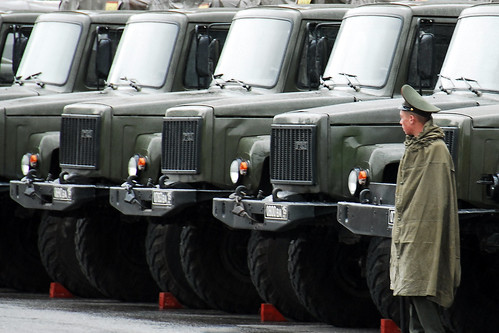
What I think is interesting about this success is not the high TV ratings; the hype of these games plus their perfect translation into prime time was a recipe for success. More impressive is the network's deft handling of internet coverage. Vast media conglomerates have a poor track record when it comes to embracing web technology (think of any business deal revolving around a social networking site - virtually none have turned a profit).

I believe traditional business models partly explain this lack of success. They lack the inherent creativity of new internet ventures that cater to the individuality and tastes of their users. Personalization and customization are hallmarks of the web and NBC hit the nail on the head by allowing users to essentially construct their own content rather than be force-fed packaged network sob stories. It's an unnoticed (but seemingly significant) contrast that the Olympics held in the one of the most authoritarian, collectivized countries in the world also saw the most success for the most open and individual domain of our generation. 

It's too bad the Chinese populace was not able to celebrate this unexpected success. 

Can capitalism and democracy be decoupled?

Frank Fukuyama had a very interesting op-ed in the Washington Post this weekend exploring the limits of authoritarianism. It ties in nicely with our recent discussions of nationalism and globalization. In a nutshell, he argues that, despite recent events, democracy and capitalism have no viable ideological alternatives. Modern China and Russia, he contends, are fuelled by nationalism, not a political-economic ideology like communism. Conversely, the Western combination of democratic capitalism is still winning the global war of ideas.

Mr. Fukuyama makes some excellent points, especially about the need to evaluate states individually instead of lumping them into categories. However, I do think that he is a bit dismissive of the idea of authoritarian capitalism. His writing belies a conviction that capitalism and democracy are natural partners, and that having one without the other is impossible to sustain.

I strongly suspect that this is the case in the 30+ year outlook: it is hard to imagine the Communist Party in China being able to maintain its grip on power when the economy stops growing so rapidly, which it will at some point. However, as Mr. Fukuyama notes, the ‘Beijing Consensus’ of free markets with closed political systems is widely appealing to many developing countries. Granted, he is probably also correct in observing that it would be difficult to replicate the model in many places, particularly states in Sub-Saharan Africa which traditionally have weak, ineffective, and corrupt bureaucracies. But that won’t stop countries like Cuba from trying to emulate the Chinese model, which speaks to its ideational power. While it’s probably impossible to permanently sever the link between economic and political freedom, perhaps it will prove feasible to temporarily decouple them.

If this is the case, is this a development that should be welcomed? In situations where authoritarianism is ‘benign’, where leaders have the long-term interests of the country in mind, it could be beneficial. Centralized governments insulated from political pressure have a freer hand to implement long-term and necessary but controversial reforms. The problem is that, by virtue of human nature, there are very few enlightened despots in the world. If we concede that most leaders have ulterior motives, combined with a monopoly on the political process, authoritarianism looks like a riskier development model. It’s possible that such leaders could engineer necessary reforms and later be forced out of power as the population grows richer and demands more freedom. But it’s also possible that leaders could use the benefits of increased economic growth to primarily reinforce their own power apparatus.

In short, ‘authoritarian capitalism’ is dangerous medicine. Conversely, capitalist democracy is inefficient, because it empowers actors who might be adversely affected by necessary economic reforms and because democracies can be weak at executing coherent long-term plans. However, it has a better human rights record and is more likely to ensure political stability, which is essential for sustained development.

Which would you choose?

(Image from Tinou Bao’s flickr photostream)

Saturday, August 23, 2008

On kidneys and coffee

Regular readers of Zeitgeist have probably noticed that I write about trade a lot. Sure I enjoy it, but I also do it because understanding trade is also key to understanding how the world works. Commerce affects our lives in more ways than we imagine. Don’t believe me? Check out these two interesting trade-related stories from just the past week:

Legalizing the organ trade? Looking at the example of Singapore, Time wonders out loud what the world would look like if it was legal to buy and sell human organs. Your initial reaction is probably one of disgust. It’s a controversial issue, and there are legitimate concerns that allowing for the sale of organs exploits the poor at the benefit of the rich. But let me play Devil’s Advocate for a minute here: if you were on a 9-year waiting list for a kidney, wouldn’t you at least want to have the option to purchase one? What if we could regulate organ markets and monitor organ trade closely? What if it solved the chronic shortage of organs (or blood, for that matter) in the public health system? Why is it that we permit the sale of reproductive materials and not organs?

Fair trade coffee. Dave over at IPE Journal raises a ‘fair’ (HA) question: does fair trade really work, or is it another one of those well-meaning ideas that does more harm than good? Dave, here’s my answer: I am personally strongly opposed to initiatives like ‘fair trade’ which seek to intervene and ‘improve’ market outcomes in the absence of demonstrable market failure. The problem is that fair trade distorts the most accurate market signal (price) and encourages overproduction, because the price is kept artificially higher than the market says the beans are worth. This is not good for producers in the long run. Fair-trade certification is also a bit like a cartel, and it disadvantages farmers without the fair-trade credentials. No sir. Kudos to fair traders for their good intentions, but in my book, fair trade is free trade, and that’s what we should be working towards. I’m in good company on this issue, as well. (Aside: I always found it funny that the cafes on the campus of the London School of Economics had more fair trade products per capita than any place other place I'd ever seen.)

So there you have it: you can look at almost any issue from a trade/commerce perspective, from public health and the kidneys you can’t legally buy, to your daily caffeine fix and the coffee that you probably pay too much for.

Friday, August 22, 2008

A bunch of hot air

Honestly, this is one of the stupidest, most pointless moments of the campaign.


Money is involved in politics?! How have we been deceived for so long! Seriously, who gives a damn how many homes John McCain owns. Didn't Barack Obama graduate from Harvard Law? Doesn't Bill Clinton charge six figures for a speaking engagement?

I was excited by this election a few months ago. Not because I thought either candidate was especially qualified or groundbreaking but because I actually believed (I know, how stupid am I) that these were men, not politicians, who were capable of engaging each other in a civil and intellectual manner. I am more than disappointed to see this campaign descend into a pissing match at a time when our country deserves so much more.

As usual, McArdle puts it better than most:

I do not think that I am engaged in a titanic battle, in which the forces of good must beat back the cosmic evil that threatens to engulf us all. I think I'm deciding which of two politicians to hand a lot of power I don't want either of them to have. It should be possible to debate the issues in this election at a level above "My guy's awesome and your guy is a big fat doody-head". But it doesn't seem to be. I find this profoundly depressing.
On this happy note, enjoy your weekend.

Thursday, August 21, 2008

The rise of nation building

Ok, last post Afghanistan or Pakistan for a while. Promise.
Today, I had the pleasure of meeting James Dobbins. He was former special envoy to Afghanistan and spoke at the New America Foundation about the lessons he learned while engineering the Bonn Agreement, which established the Afghan government following the US invasion and was a foundation for their new Constitution. His discussion leant itself toward more technical aspects of political development and nation building but allow me to summarize two of his more interesting points regarding the current situation in South Asia.

The Pakistani government regards the current conflict in FATA as a problem between the US and extremists NOT as a problem between Pakistan and extremist militants.

I have said something to this effect before. A large part of this sentiment stems from Pakistan's longstanding support of separatist rebels in Kashmir. The country has a history of harboring extremist groups that may benefit Pakistan at some point (and the Taliban serves to counter Indian influence in Afghanistan).

The current icy relations with Iran are a result of misguided confidence in Iraq.

This sounds controversial. Conventional knowledge says Iran has been adversarial since Khomeini came to power. Not true. Iran has played an instrumental role in the reconstruction (and financial support) of Afghanistan and wanted to be heavily involved in development efforts. By shunning Iranian attempts to aid in reconstruction (when they were willing to capitulate to a host of US demands), the Bush administration seriously miscalculated their position. Seeing quick "success" in Afghanistan and hoping for the same after a quick military takeover of Iraq, Rumsfeld's belief was that once surrounded by two functioning democracies, built from the ground up by the US and allies, Iran would be forced to meet ALL US demands. Well I don't need to remind you that's not quite how events unfolded.

These were two of the more interesting and provoking stances Dobbins took but the entire event is worth checking out.

The return of history

Eric Posner over at the Volokh Conspiracy makes an interesting prediction:

"When historians write about the post-cold war era, which began in 1989, the date of its termination will not be 9/11/2001, as has been frequently claimed, but 8/7/2008, when Georgian forces attacked separatists in South Ossetia and Russia responded with an invasion. August 7 marks the end of American sole-superpowerdom, or hyperpowerness, or hegemony, or whatever you want to call it, an interval somewhat longer than but still very similar to the periods of global preeminence the United States enjoyed for a few years after World War I and World War II."

The war in Georgia has sparked some intense reflection on the state of international relations and American power. I agree that the American moment of hyperpower (I really love that term) is over. But this was never an unexpected development: the US used its hegemonic position after the Second World War to foster a liberal international economic order and promote stability, mutual economic cooperation, and growth. But hegemony is a concept that measures states’ relative power capacities, so by encouraging a system which facilitates world economic growth, sooner or later America’s power would decline in relation to the rest of the world. As hegemonic stability theory teaches us, a good hegemon sows the seeds of its own decline.

International relations is driven by political and economic factors. The political events by which we mark history may lead us to conclude that America’s decline is something new, but in reality the economic forces which caused it have occurred gradually since the end of World War II. Thus, while perhaps the political environment after the Cold War suggested an ‘end to history’, a cursory look at the world’s economic structure would have cautioned that, at best, history was taking a short break.

In any case, the world has certainly woken up. State relations will need to evolve to accommodate a new power structure, but I am not particularly pessimistic about a multipolar world. Today, the US is still the world’s most powerful nation politically, militarily, and economically. The United States will continue to lead but increasingly will need to engage with other nations on less favorable terms. That said, we should be careful not to overestimate the importance of Russia’s recent actions in Georgia. Economic growth has empowered both potential rivals like Russia and new partners like Brazil and India.

In many ways, Russia is an outlier in modern international relations and may need to be treated as such. Its wealth is based largely on strategic energy reserves. It is a bully when it comes to trade (look at its relations with the EU regarding natural gas.) But if you look at the other BRIC countries, you see economies with strong global links that have an interest in systemic stability. It is more likely that such countries can become “responsible stakeholders” in the global political-economic structure.

History clearly isn't over. But then again, it never was.

(Related: see Rory’s excellent treatment of the resurgence of nationalism over at IPE Journal)

Wednesday, August 20, 2008

In cahoots? Or, T. Boone Pickens II.

Flying under the media radar (poor pun completely intended) is Mayor Bloomberg's newest authoritarian plan for New York: wait for it...wind power!

Announced yesterday, Mr. Bloomberg's proposed urban makeover would place wind turbines of varying shapes and sizes - and one should assume, efficiency - all over the New York skyline (talking with Pickens much?). No one said the man was not ambitious (remember his congestion tax?!) but this is a plan that deserves support. Though this exact proposal will never come fully into effect it is worth monitoring. Despite the NIMBY sentiments most New Yorkers will loudly and proudly voice, their city presents a perfect laboratory for testing the feasibility of future renewable energy.

New York is about as urban, regulated, and crowded a city one can find in the West. If Bloomberg can streamline the city's energy systems, legal hurdles, and population into a coherent framework for instituting his idea, the world will be forced to consider such plans much more seriously.

Besides, if he's wrong the city loses nothing and will probably wind up with a more efficient political and regulatory environment. And if Bloomberg's right? Well then the world will be shown that even a city that never rests won't be running on empty anytime soon.

Trade on the march in Southern Africa

Interesting news that might have slipped under the radar: this past weekend, the Southern African Development Community (SADC) officially launched a free trade area (FTA), as outlined in its Regional Indicative Strategic Development Plan (RISDP). The free trade zone encompasses 12 countries and nearly 250 million Africans, and they don’t plan to stop there. The plan calls for a customs union by 2010 (free trade with a common external tariff), a single market by 2015 (customs union plus free movement of goods, labor, services, capital), monetary union by 2016 (all currencies fixed to one another with the goal of creating a single currency and monetary policy), and a single currency and central bank by 2018.

The idea behind the SADC’s FTA is to promote regional economic integration, create trade, enhance collective bargaining power, and encourage the development of economies of scale. This is pretty standard stuff for an FTA. It could make the SADC a more attractive place to do business because of the expanded tariff-free zone. But corruption, regional political instability, and violent risks are still rife. I do also wonder about the trade creation claims (how much intra-SADC non-commodities trade goes on right now?) I’d be curious to see some figures on export penetration from China and other countries to see if trade diversion is a real concern. Once the member nations progress to a customs union, one indicator would be if the tariff schedule for basic manufactures and agricultural products in the common external tariff framework is suspiciously high.

Nonetheless, I see this as largely a positive development. With the exception of South Africa, many of these countries are poorly integrated into the multilateral trading system and are indifferent traders. Perhaps regional economic integration will be a shot in the arm. Yes, I realize that this leaves me open to criticism given my position on regional trade agreements, but we shouldn’t let the perfect be the enemy of the good in such situations. (I promise I’ll write that post detailing my thoughts about economic regionalism very soon.)

I’m most concerned about the ambitious timeline for further regional integration. A customs union should be doable, but after that further integration becomes enormously difficult. We’re talking about liberalizing capital flows, immigration policies, and investment regulations, among other things. These are difficult technical issues which require sustained (and highly competent) government commitments to successfully execute. And a monetary union? Is the SADC an optimal currency area? And do the member states have the monetary discipline (or, for that matter, capacity) to fix their respective currencies and establish a convincing peg?

We should remember that the world’s preeminent economic and monetary union took more than 40 years to progress from the Treaty of Rome to the introduction of the euro. And this was put together by some of the world’s most advanced countries. Considering that the perfect can be the enemy of the good, I do hope that the SADC’s over-ambitious plans don’t cause an otherwise encouraging project to fall apart.

Tuesday, August 19, 2008

Going, going, gone

Despite my obvious interest in Pakistan, I did not want to write about Musharraf's resignation until I had some time to really think about the implications. There has been plenty of commentary, most of which is missing the point.

Musharraf was an army man at heart who eschewed democracy for iron fisted control of the military and intelligence communities. His biggest accomplishment was holding onto power for this long. Just after that was his ability to hoodwink the US into believing he was the man who could lead the region into stability. 

History will wait to judge Musharraf until Pakistan's position in the geopolitical realm is resolved. If Pakistan remains stable and is able to control extremism (it will never be fully stamped out), he will be praised for his military prowess and vision in aligning Pakistan with the US. If Pakistan slides deeper into decline and becomes a lawless frontier, then he will be blamed for not doing enough and leaving the civilian government with its hands tied. The truth is that, as much as people call for the coalition to stay strong, they will continue to quibble over the problematic domestic issues that hang over the country (judges, inflation, and violence).

Matthew Yglesias almost gets it right. The US needs a Pakistan policy that is not based on a "new Musharraf" or other figurehead; but this is simply not possible. Pakistani politics, like the Indian variety, are based on cults of personality. Until Pakistani political discourse becomes rooted in policy and not people, the US has little chance of influencing the country's course. The only possibility of guiding Pakistan to a more stable economy and democracy is to divert money from the military to development schemes. If we can build private enterprise and political participation, perhaps the people of Pakistan will demand more from a better leader. Unfortunately, the rudder remains up for now.

Distance makes the heart grow fonder

Last week, I blogged about the rising cost of transportation and whether it would unravel global supply chains, a key component of global economic integration. My answer: rising oil costs matter, but probably not enough to do real damage in the 1 -3 year outlook. In my mind, the real question is whether another decade of rising oil prices dampens new investment in delocalized production chains.

Now we have this fascinating analysis from C. Meissner and D. Novy via VoxEU, which argues that higher shipping costs are unlikely to affect international trade. Using a gravity model, the authors contend that transportation costs actually fell faster in the first era of globalization than the current one (defined as 1945 - present), and that in our era, falling transportation costs have only accounted for about a third of the increase in trade.

Drawing on other research, they further argue that the tariff equivalent of international trade (i.e. the total additional cost to producing something abroad and moving it across domestic borders to markets) is about 74%, only a third of which is transportation-related. This is a reassuring analysis, which implies that countries should still be able to trade in the face of higher transportation costs. The authors also note that protectionist measures in the interwar period effectively strangled international trade and conclude that "unless there is a backlash in the form of rising protectionism, world trade has the potential to keep growing strongly over the coming decades."

Given our present global situation, this raises two questions. First, how worried should we be about a strong upswing in protectionism? I'm not suggesting that we are near a point politically or economically where we could plausibly see a new Smoot-Hawley Tariff. But protectionism is always a worry, given public scepticism about globalization and sluggish economic performance. According to the always insightful Dan Drezner and his Protectionism Advisory System, our current warning level is: Edge of the Cliff (level 2 of 5).

Second, if trade continues to expand, should be worried about the kind of trade we end up with? With the Doha Round on the ropes, the future of multilateral trade is murky. However, as I've said repeatedly, further economic regionalism seems almost certain. It will be interesting to observe what effect preferential trade agreements have not just on channeling trade flows, but the overall volume of trade as well.

Monday, August 18, 2008

Help us help you (suggestions open thread)

You may have noticed that we've undergone a few stylistic changes here at Zeitgeist. We've cleaned up the tag cloud (now top right), changed the fonts and colors, and, best of all, added a fancy new header. Many thanks to AT (pictured, far left) for his sweet photoshopping, bow-hunting, and computer hacking skills. If you subscribe to our feed or email and don't actually visit the website, I'd encourage you to click through and check it out.

We've been doing this for almost two months now and we're having a great time with it. But we never forget who the boss is, so what other sorts of blog features do you guys want? Improved sharing options? Comment on a particular issue (issues)? More Chavez-bashing? Now's your chance to make a suggestion - the band is taking requests, and we will play Freebird if you ask nicely.

Up, down, all around

They say there's no cure for high prices like high prices. It really feels like this is what happened with commodities: after a while, the prices just got high enough to weaken demand. As I mentioned briefly a week or so ago, commodities markets have been falling fast recently, led by oil and gold but including most of the base metals and agricultural commodities as well. Most of us will be breathing a huge sigh of relief - the government says gas prices are at a 14 week low, and food prices should nudge downward a bit as the USDA is predicting record global harvests.

It will be interesting to watch whether or not the dollar can continue its ascent. As I've written before, I'll be surprised if oil goes much lower than it does, and of course, this doesn't solve any major problems over night. There's still strong, fundamental, long-term demand for more food, energy, construction materials, etc. But hey, it's still summer: let's enjoy it while we can. Maybe now you can afford to drive to the beach.

Update: Perhaps I spoke too soon about food prices easing: as of August 21st, the USDA is predicting the largest rise in food prices since 1990.

Collective isn't a four letter word

Chris Blattman had an interesting post up today on the roots of group action. Drawing on his field experience in Liberia, he offers an anecdote that seems to reveal he believes that collective action is a social phenomenon capable of improving the efficacy of international aid.

It is an interesting conception. He is right in saying that donors prefer to give money to "groups". Agencies like to work with organizations as it offers a sense of legitimacy and allows for a more for formalized relationship than could exist with unorganized communities or individuals. More importantly, such group think or collective action can promote greater civic engagement, pride and hopefully efficiency and production. This is not a new idea: de Tocqueville surmised that American civic associations were behind our unique embrace of a radically new political (and resultant economic) system. More recently, Robert Putnam gained notoriety with Bowling Alone, his work that equated the decline of American power with lower rates of social interaction and public discourse.

The premise seems rather obvious. Our social capital, the net worth of our relationships and the "wealth" they create, increases if we participate in group life. Blattman gets at the real question though: how do we encourage this type of behavior in the context of war-torn or otherwise struggling states? Attaching strings to aid money is not enough. If anything, it favors those who already have enough access to influence and power to initiate the formation of such groups. What is required is a structural shift in how we disseminate aid. Incentives are a good place to start. I'm generally somewhat skeptical of the merits of libertarian paternalism but this seems to be a good test case for wielding such soft influence.

Whether governments, institutions, or donors steer people toward collective action, if it yields better results it can only help the efficiency of, and in turn argument for more, foreign aid.